live tv

Friday, 24 February 2012

" asan san khachareyun ku dosto.halyawedasen "

Friday, 3 February 2012

madina tayba


cid:image018.gif@01CCC923.48844C90
cid:image016.gif@01CCC923.48844C90
Al Haramain High-Speed Rail Stations in Kingdom of Saudi Arabia

The Haramain High-speed Railway is a major infrastructure project for the Kingdom of Saudi Arabia, connecting the cities of Makkah, Madinah, Jeddah and the developing King Abdullah Economic City (KAEC). The stations are conceived as gateways to each city, filled with places to meet, shop, eat and shelter from the sun. Altogether, the large, flexible stations will cover an area more than 30 times the size of London’s Trafalgar Square and will initially accommodate an anticipated 60 million passengers – approximately six times the number of passengers that take the Eurostar from St Pancras each year. This is expected to increase to 135 million passengers by 2042.


KAEC Station
  • Architects: Foster + Partners
  • Project: Al Haramain High-speed Rail Stations
  • Location: Kingdom of Saudi Arabia
  • Client: Saudi Railways Organisation
  • Collaborating Architect: Dar Al Riyadh
  • Cost Consultant: Davis Langdon
  • Structural Engineers: Buro Happold
  • Foster + Partners Team: Mouzhan Majidi, Luke Fox, Angus Campbell, Huw Thomas, Alistair Lenczner, Angelika Kovacic, Jurgen Kuppers, Tony Miki, Pearl Tang, Vincent Westbrook, Young Wei-Yang Chiu, Diogo Bleck, Melissa Clinch, Perry Ip, Dirk Jantz, Charbel Tannous

Jeddah Station
  • Mechanical Engineers: Buro Happold
  • Landscape Architect: Capita Lovejoy
  • Lighting Consultant: Jason Bruges Associates
  • Lift Consultant: Buro Happold
  • Fire Consultant: Buro Happold
  • Facade Consultant: Buro Happold
  • Appointment: March 2009
  • Construction: January 2011 – May 2013
  • Number of Stations: 4 (Makkah, Jeddah, KAEC and Madinah)
  • Building Height: Jeddah, KAEC – top of roof +27.7meters; Maddinah, Makkah – top of roof – +24.7meters
  • Modular Components: Roof, superstructure, internal fit-out elements
  • Structural systems: Steel roof system + pre-cast concrete superstructure
  • Main materials: In situ concrete super-structure, steel roof structure, GRP roof, metal mashrabiya, metal and glass facade, fabric platform roof
  • Sustainability: Maximised shading and use of daylight (5% opening), passive cooling in platform and grey water recycling.


Jeddah Station

The modular approach to the stations’ design is complemented by variations in colour, which signify the four cities while remaining emblematic of the HHR system. The terminal stations of Medina and Makkah are characterised by a rich colour palette: Makkah Station references the gold leaf of the decorated Kab’ah and the city’s significance as a holy site, while Madinah Station’s vivid green colour draws inspiration from the Mosque of the Prophet. Jeddah Station features a shade of purple which has a particular resonance with the city and KAEC’s station is a futuristic blue and silver, representative of its role as a modern new city. Drawing on Islamic architecture, the design concept takes the traditional gateway arch form as the basis for its roof design. The design, common to all stations, features a sequence of 25-metre-high arches rising from the concourse, complemented by smaller 9-metre-high arches at platform level. Supported by freestanding structural trees, repeated on a 27-metre square grid, the arches connect to form a flexible vaulted roof.


KAEC Station

By following the direction of the trains, the arrangement of spaces helps passengers navigate the stations intuitively, with few level changes and the interior spaces provide respite from the heat of the desert. Following a ‘kit-of-parts’ approach, each station has a combination of different facades according to their orientation – solid facades are used where visibility is not essential, in order to reduce solar gain. The glazed entrances to the concourse and the platforms are concealed behind a combination of external mashrabiya and the deep overhanging roof canopies. Each station is oriented according to the path of the sun, turning from Madinah Station, which faces east, to north-facing Makkah Station. Their changing position is articulated through openings in the roof, through which light tubes draw daylight down to the concourse level and animate the space. At night, spotlights between the perforations give the impression of stars in a night sky. Spherical chandeliers, suspended between the arches, provide focused lighting, mediating between the scale of the roof and concourse level and accentuating the rhythm of the structure.


Madinah Station


Makkah Station


Jeddah Station
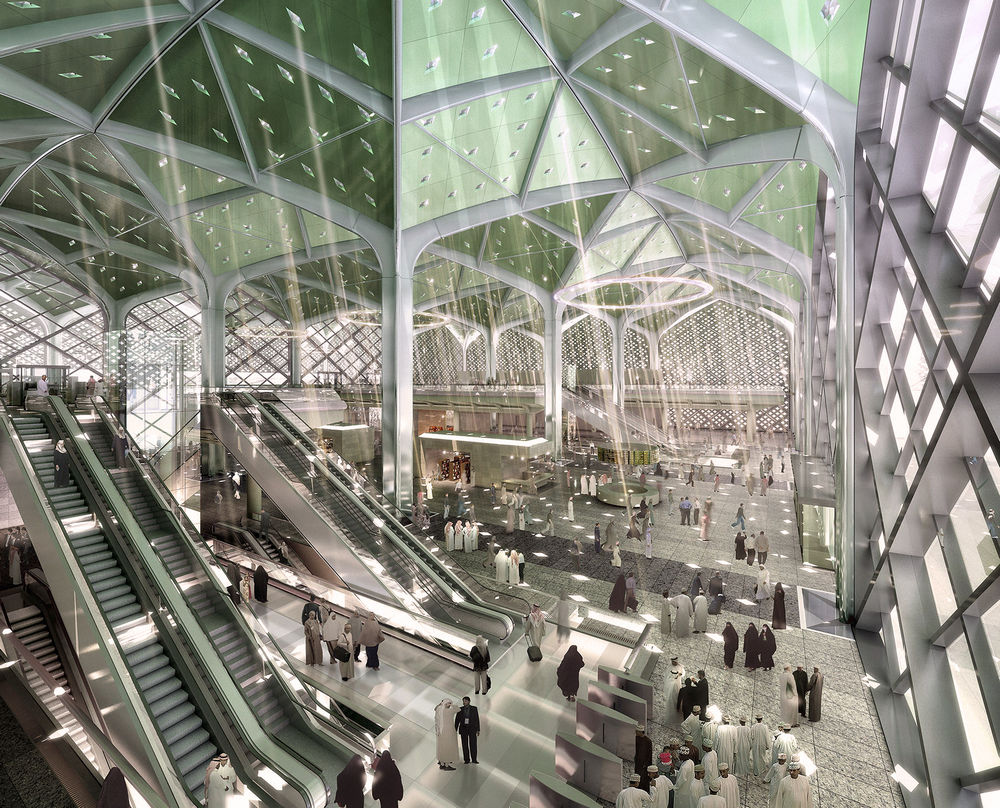

Madinah Station


“And remind (by preaching the Qur’an, O Mohammad SalAllahualaihiwasallam.bmp), for verily, the reminding profits the believers.”
<Surat: Adh-Dhariyat (51); Ayat # 55>


http://www.wix.com/rajasindhi1/almustafa


https://sites.google.com/feeds/content/site/almustafagarment2012-02-03T13:30:41.920ZPosts of Homework AssignmentsGoogle Sites1https://sites.google.com/feeds/content/site/almustafagarment/20231205610234617372009-10-13T07:58:00.924Z2012-02-03T13:17:55.138Z2012-02-03T13:17:55.138ZHomework For Week of October 11th
Lorem ipsum dolor sit amet, consectetur adipiscing elit. In tincidunt nisl felis. Praesent laoreet mollis justo id ornare. Curabitur congue, odio vel faucibus interdum, felis magna euismod ante, id dignissim lectus libero id nisl. Nunc justo arcu, eleifend in congue id, tempus et lorem. In ultricies tincidunt posuere. Duis ut commodo urna. Vestibulum tellus felis, faucibus eget blandit eu, egestas eu mi. Proin posuere adipiscing mollis. Nam sit amet neque erat. Nulla ac fringilla est. Suspendisse lacinia cursus imperdiet. Maecenas id ultricies eros. Mauris lacinia nibh et nunc porta laoreet facilisis ipsum consequat. Praesent id felis in ligula vestibulum hendrerit. Suspendisse tincidunt velit ut mi bibendum nec commodo sem consequat.
Rajja Sindhirajasindhi2@gmail.comhomeworkforweekofoctober11th1
https://sites.google.com/feeds/content/site/almustafagarment/60036794712357462402009-10-15T08:24:22.497Z2012-02-03T13:17:55.138Z2012-02-03T13:17:55.138ZHomework For Week Of October 25th
Lorem ipsum dolor sit amet, consectetur adipiscing elit. In tincidunt nisl felis. Praesent laoreet mollis justo id ornare. Curabitur congue, odio vel faucibus interdum, felis magna euismod ante, id dignissim lectus libero id nisl. Nunc justo arcu, eleifend in congue id, tempus et lorem. In ultricies tincidunt posuere. Duis ut commodo urna. Vestibulum tellus felis, faucibus eget blandit eu, egestas eu mi. Proin posuere adipiscing mollis. Nam sit amet neque erat. Nulla ac fringilla est. Suspendisse lacinia cursus imperdiet. Maecenas id ultricies eros. Mauris lacinia nibh et nunc porta laoreet facilisis ipsum consequat. Praesent id felis in ligula vestibulum hendrerit. Suspendisse tincidunt velit ut mi bibendum nec commodo sem consequat.
Rajja Sindhirajasindhi2@gmail.comhomeworkforweekofoctober25th1
https://sites.google.com/feeds/content/site/almustafagarment/60405496717027826272009-10-13T07:58:48.101Z2012-02-03T13:17:55.138Z2012-02-03T13:17:55.138ZHomework For Week Of October 18th
Lorem ipsum dolor sit amet, consectetur adipiscing elit. In tincidunt nisl felis. Praesent laoreet mollis justo id ornare. Curabitur congue, odio vel faucibus interdum, felis magna euismod ante, id dignissim lectus libero id nisl. Nunc justo arcu, eleifend in congue id, tempus et lorem. In ultricies tincidunt posuere. Duis ut commodo urna. Vestibulum tellus felis, faucibus eget blandit eu, egestas eu mi. Proin posuere adipiscing mollis. Nam sit amet neque erat. Nulla ac fringilla est. Suspendisse lacinia cursus imperdiet. Maecenas id ultricies eros. Mauris lacinia nibh et nunc porta laoreet facilisis ipsum consequat. Praesent id felis in ligula vestibulum hendrerit. Suspendisse tincidunt velit ut mi bibendum nec commodo sem consequat.
Rajja Sindhirajasindhi2@gmail.comhomeworkforweekofoctober18th1


https://sites.google.com/feeds/content/site/familytemplate_en2012-02-03T13:27:30.805ZPosts of Family blogGoogle Sites1https://sites.google.com/feeds/content/site/familytemplate_en/35752363526823160222009-11-09T18:59:42.872Z2009-11-09T19:43:34.989Z2009-11-09T19:43:34.989ZWelcome to our family site
This is a great way to keep up to date on your family news.


Tip: How to delete this post.
Sample Usersitestemplatedata@gmail.comwelcometoourfamilysite-11

Sunday, 22 January 2012


Aesop's Fables

This famous Book of Fables, which are always referred to as
Aesop's Fables, date back to the 5th Century BC

 
What are Fables?
Fables are short stories which illustrate a particular moral and teach a lesson to children and kids. The theme and characters appeal to children and the stories are often humorous and entertaining for kids of all ages. Fables can also be described as tales or yarns which have a message in their narrative such as a parable might have. Fables can often pass into our culture as myths and legends and used to teach about morals to children and kids.

The Characters of Fables?

The characters of fables and tales are usually animals who act and talk just like people whilst retaining their animal traits. This theme is especially appealing to children and kids. 

Aesop's Fables

Aesop's famous fables and scripts provide great entertainment for children and kids. The fables, or stories, are all very short so keep the attention of children and Aesop's fables feature familiar animals loved by children and kids.
 
Androcles Fable
Avaricious and Envious Fable
Belling the Cat Fable
Hercules and the Waggoner Fable
The Ant and the Grasshopper Fable
The Ass and the Lapdog Fable
The Ass and the Charger
The Ass, the Fox, and the Lion
The Ass in the Lion's Skin Fable
The Ass's Brains Fable
The Bald Man and the Fly Fable
The Bat, the Birds, and the Beasts Fable
The Belly and the Members Fable
The Boys and the Frogs
The Buffoon and the Countryman Fable
The Bundle of Sticks Fable
The Camel and the Arab
The Cat Maiden Fable
The Cock and the Jewel
The Cock and the Pearl Fable
The Crow and the Pitcher Fable
The Dog and the Shadow Fable
The Dog and the Wolf Fable
The Dog in the Manger Fable
The Dog Invited to Supper
The Dogs and the Hides
The Dove and the Crow
The Eagle and the Arrow Fable
The Fisher Fable
The Fisher and the Little Fish Fable
The Fisherman and the Little Fish
The Four Oxen and the Lion Fable
The Fox and the Cat Fable
The Fox and the Crow Fable
The Fox and the Goat Fable
The Fox and the Grapes Fable
The Fox and the Lion Fable
The Fox and the Mask Fable
The Fox and the Mosquitoes Fable
The Fox and the Stork Fable
The Fox, the Cock, and the Dog Fable
The Fox Without a Tail Fable
The Frog and the Ox Fable
The Frogs Desiring a King Fable
The Goose With the Golden Eggs Fable
The Hare and the Hound
The Hare and the Tortoise Fable
The Hares and the Frogs Fable
The Hare With Many Friends Fable
The Hart and the Hunter Fable
The Hart in the Ox Stall Fable

The Horse and the Ass Fable
The Horse and the Stag
 
The Horse, Hunter, and Stag Fable
The Jay and the Peacock Fable
The Labourer and the Nightingale Fable
The Lion and the Boar
The Lion and the Mouse Fable
The Lion and the Statue Fable
The Lion in Love Fable
The Lion's Share Fable
The Lion, the Fox, and the Beasts Fable
The Man and His Two Wives Fable
The Man and the Satyr Fable
The Man and the Serpent Fable
The Man and the Wood Fable
The Man and the Wooden God Fable
The Man, the Boy, and the Donkey Fable
The Milkmaid and Her Pail Fable
The Mischievous Dog
The Miser and His Gold Fable
The Monkey and the Dolphin
The Mountains in Labour Fable
The Mouse, the Frog, and the Hawk
The Nurse and the Wolf Fable
The Old Hound
The Old Man and Death Fable
The Old Woman and the Wine Jar Fable
The One-Eyed Doe Fable
The Ox and the Frog
The Peacock and Juno Fable
The Serpent and the File Fable
The Shepherd's Boy Fable
The Sick Lion Fable
The Sick Stag
The Stag at the Pool
The Swallow and the Other Birds Fable
The Thief and the House-Dog
The Tortoise and the Birds Fable
The Town Mouse and the Country Mouse Fable
The Tree and the Reed Fable
The Trees and the Axe
The Trumpeter Taken Prisoner Fable
The Two Crabs Fable
The Two Fellows and the Bear Fable
The Two Frogs
The Two Pots Fable
The Vain Jackdaw
The Vine and the Goat
The Wind and the Sun Fable
The Wolf and the Crane Fable
The Wolf and the Horse
The Wolf and the Kid Fable
The Wolf and the Lamb Fable
The Wolf in Sheep's Clothing Fable
The Woodman and the Serpent Fable
The Young Thief and His Mother Fable

When were the first of Aesop's great Book of fables written?

It is not known exactly when the first Book of Aesop's fables were written as the fables were originally handed down from one generation to the next just like a myths, tales and legends. It is, however, believed that Aesop lived from about 620 to 560 B.C.
Who is Aesop?
Who is Aesop? Aesop is the name of the man credited with the authorship of a collection or book of  fables. Aesop was a slave who many believe lived in Samos, a Greek island in the eastern Aegean Sea but others say he came from Ethiopia. The name of his first owner was Xanthus. It is believed that he eventually became a free man. In Aesop's biography Planudes describes Aesop an ugly, deformed dwarf, and the famous marble statue at the Villa Albani in Rome depicts Aesop accordingly.
Aesop's Statue in Rome
Who is Aesop and where was he born?
There are many possibilities relating to Aesop's place of birth, although he certainly spent much of his life living in Greece at the court of King Croesus in Athens. Suggestions for Aesop's place of birth include Thrace, Greece, Phrygia, Ethiopia and Samos.
Who is Aesop and what did he look like?His very name, Aesop, may however give us a clue to his country of origin. The name Aesop is derived from the Greek word Aethiop which means Ethiopia! And Aesop was described by Maximus Planudes (c.1260-c.1330), the Byzantine scholar who wrote a biography of Aesop and a prose version of Aesop's fables, as follows "His visage was of black hue". In Aesop's biography Planudes describes Aesop an ugly, deformed dwarf, and the famous marble statue at the Villa Albani in Rome depicts Aesop accordingly.
When were Aesop's famous fables first translated into English?
Aesop's fables were first printed in English by William Caxton in 1484, from his own translation made from the French. Aesop's fables were not believed to have been written as Children's literature and the book of fables were originally used to make thinly disguised social and political criticisms. The similarity to parables or allegories can be seen in most of the short tales in Aesops Book of Fables.
Aesop's fables?
Many of Aesop's fables in this compilation from the book have in fact since been found on Egyptian papyri known to date between 800 and 1000 years before Aesop's time. This clearly cast doubts on the authorship of many of the fables attributed to Aesop and the Aesop's Fables book. Many of the fables were possibly merely compiled by Aesop from existing fables, much in the same way that the Mother Goose Nursery Rhymes were but a new compilation of existing rhymes! 


The Morals, Sayings and Proverbs featured in Aesop's fables
Each one of Aesop's fables has a lesson, or moral,  to teach to children - just like a parable or allegory. A moral is added at the bottom of each of Aesop's fables. Many of the Morals, Sayings and Proverbs featured in Aesop's fables are well known today. Some of the most famous morals are as follows:
  • Moral - "Appearances often are deceiving." - Aesop's fables: The Wolf in Sheep's Clothing
  • Moral - "Familiarity breeds contempt." - Aesop's fables: The Fox and the Lion
  • Moral - "Slow and steady wins the race." - Aesop's fables: The Hare and the Tortoise
  • Moral - "One person's meat is another's poison." - Aesop's fables: The Ass and the Grasshopper
  • Moral - "Things are not always what they seem." - Aesop's fables: Bee-Keeper and the Bees
  • Moral - "Never trust a flatterer."- Aesop's fables: Fox and the Crow
  • Moral - "Beware the wolf in sheep's clothing." - Aesop's fables: The Wolf in Sheep's Clothing
  • Moral - "Little friends may become great friends." - Aesop's fables: Lion and the Mouse
The Morals, Sayings and Proverbs featured in the Book of Aesop's fables ensure that they still have meaning for us today.
Free, online book of Aesop's fables
All of the famous fables by Aesop are featured on this site. They are printer friendly and the favourite of these kids and children's fables can be chosen and printed to create a tailor made book of children's fables by Aesop. Click here for other famous short stories.
 

Who is Aesop?

  • Nationality of Aesop - Ethiopian or Greek or Greek
  • Lifespan of Aesop - He lived approximately 620 - 560 BC
  • Life of Aesop - Slave - Author of the book of fables
  • Famous Works - Aesop's Fable book featured:
     "The Goose With the Golden Eggs",  "The Fisher",
    and "The Sick Lion"
  • Our Free Aesop's Fables have a moral to the tale or story which is useful to use in the education of kids and children.